Phytophthora Root Rot: Diagnosis, Favorable Conditions and Management
Published 2026-11-18
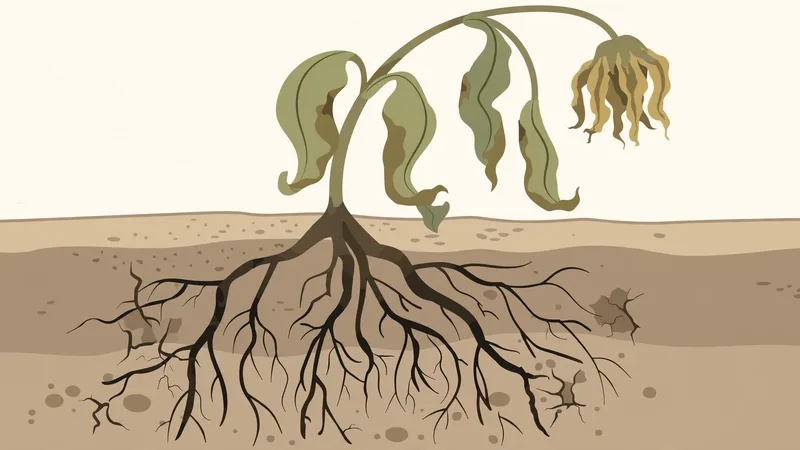
Phytophthora root rot is a disease of wet soil. Plants wilt even though the soil is moist, and watering them makes them worse, not better — because the cause is not thirst but rotted roots. Phytophthora species are oomycetes, water moulds that produce swimming spores in saturated soil, and they attack the roots and crown of a very wide range of crops, from annuals and vegetables to stone fruit and soybean. The diagnosis is made below ground: brown to black, soft, rotting roots, and a reddish-brown discoloration at the crown. Above ground you see only the consequences — stunting, yellowing, wilting and dieback. There is no cure for an established infection; the work is drainage, planting practice, clean material and protecting the healthy plants that remain.
Phytophthora root rot: the wilt that watering makes worse
What Phytophthora is
Phytophthora is a genus of oomycetes — fungus-like organisms, more closely related to brown algae than to true fungi. That matters for control, because many fungicides that work on true fungi do not work on oomycetes. In the presence of water, Phytophthora produces sporangia that release zoospores: tiny spores with tails that swim through saturated soil to reach new roots. It also survives in soil from season to season as thick-walled resting spores, so once a bed is infested the pathogen cannot be eradicated without extreme measures, as NC State Extension states. Different species attack different crops — Phytophthora cinnamomi on avocado and many ornamentals, Phytophthora sojae (formerly P. megasperma f. sp. glycinea) on soybean, several species on stone fruit — but the pattern is the same: water moves it, wet soil favours it, and the damage is done out of sight, below the soil line.
Symptoms: above ground you see the echo, below ground the cause
Above ground, affected plants are stunted, yellowed, wilted or dying back, often first in low areas where water accumulates. Shoot growth is poor — on stone fruit, the University of Illinois notes that insufficient shoot extension is often the first aboveground sign, and trees are often affected 4 to 6 years after planting. Leaves may be small and pale, and the canopy thins. The decisive check is below ground. Dig up a declining plant, or clear soil from the base, and look at the fine feeder roots: healthy roots are pale, firm and flexible; infected roots are brown to black, soft, and may be mostly decayed. At the crown — the stem base just below the soil line — scrape away the outer bark with a knife: healthy tissue underneath is white or green, while Phytophthora leaves a reddish-brown to dark discoloration with a distinct margin between diseased and healthy tissue. On soybean, a dull dark brown discoloration of the lower stem begins at the soil line and progresses upward, often into the lowermost side branches. If the plant is wilting in wet soil and the roots are brown and rotting, Phytophthora is a strong suspect. If the roots are white and firm, look elsewhere — drought, a vascular wilt, or a nutrient problem.
Conditions that favour it
Water is the dominant driver. Saturated soils, poor drainage, overwatering, prolonged canopy wetness and standing water all favour disease development, and low spots, heavy or compacted soils and hardpans that perch water in the root zone are hotspots. In soybean, Illinois records that Phytophthora root and stem rot is most severe in low, wet, poorly drained, high-clay soils, and that during wet years losses in severely diseased fields can exceed 60 percent of a stand and 50 percent of potential yield — figures for Illinois soybean in wet years, not a universal loss rate. Infection usually occurs when the soil is saturated, and development is favoured by wet and warm conditions, though the exact temperature range varies by species and host; in soybean the disease depends heavily on cool, wet weather at planting. The pathogen spreads within and between fields on infested machinery and in irrigation water, especially surface water. A useful diagnostic rule follows from all of this: if the problem is worst in the wettest part of the field, think Phytophthora; if it is worst in the driest part, think drought or a different root problem.
Diagnosis: field check, then lab confirmation
On-site identification is difficult because the symptoms resemble other diseases — NC State says so directly — so treat a field check as a strong suspicion, not a verdict. The field check is: wilt in wet soil, brown rotting roots, reddish-brown crown discoloration with a clear margin, worst in low or poorly drained spots, with a recent history of standing water or overwatering. Confirm it by sending a sample to your local extension diagnostic clinic: whole plants with roots and a bag of soil from the root zone, collected as the sample guide in this series describes, with notes on drainage, irrigation and where in the field the problem is worst. A lab can identify the Phytophthora species, which matters because species differ in host range and in which resistant rootstocks or fungicide groups are relevant. Do not start a fungicide programme on a field guess — oomycete fungicides are specific, and the wrong one wastes money.
Management: drainage first, everything else second
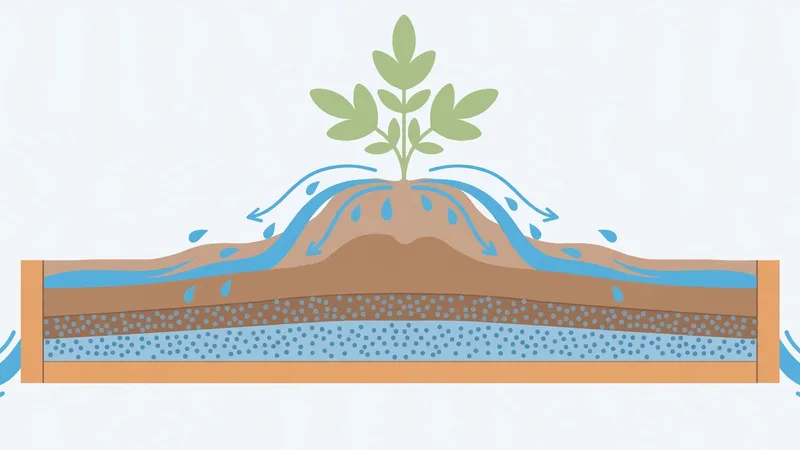
Fixing the water is the control. No fungicide compensates for a planting that sits in saturated soil, because zoospores swim and every irrigation re-infects the roots. Site selection comes first: do not plant susceptible crops in known wet hollows; grade to remove low spots; break up compacted layers; use raised beds or plant high, with the crown or graft union above the surrounding soil level, so the most vulnerable tissue stays out of standing water. Irrigate to the crop, not to the schedule: let the root zone drain between irrigations, avoid keeping the crown wet, and prefer drip or trickle irrigation over overhead watering that saturates the soil surface. Use clean, healthy planting material and inspect plants above and below ground before accepting them into a greenhouse or nursery. Use resistant rootstocks or tolerant hosts where they exist — in stone fruit, for example, Mazzard cherry rootstocks are more resistant than Mahaleb to some Phytophthora species, according to Illinois. Remove and destroy infected plants, clear debris and soil before applying any sanitiser (sanitisers lose activity on contact with organic material), and increase organic matter to support a biologically active soil. Soil solarisation of infested beds in the warmest part of the year may reduce the pathogen, but it is not a guaranteed clean-up. Fungicides in the oomycete-active groups (such as phosphorous acid products, where labelled) may be used preventively to protect healthy tissue — always check the current US label for the crop and state, and never as a cure for rotted roots.
What to do next
Find the wettest plants in the crop and dig one up today. Brown, rotting roots and a reddish-brown crown mean Phytophthora is likely: stop watering that area, improve the drainage, and send roots plus soil to your local diagnostic clinic. Then fix the water — raised beds, better grading, irrigation that lets the root zone drain — before you spend anything on a spray.
Check a wilting plant
Answer a few questions about the wilt and get a likely match — then dig and check the roots as this article describes.
Advisory note
This article is advisory guidance, not a definitive diagnosis. A photo-based check can narrow down the likely disease, but only laboratory confirmation or an extension officer's field visit gives a certain diagnosis. Never spray on the basis of a blog post alone — check the current product label and your local agriculture department advice first. No pesticide doses are given in this article.
By Ghulam Mustafa — Final-year BSc (Hons.) Agriculture student, specialising in Plant Pathology, The Islamia University of Bahawalpur (IUB), Pakistan. CGPA 3.98/4.00.
Frequently asked questions
How do I know if my plant has Phytophthora root rot?
The trigger is wilting in wet soil that does not recover after watering. Confirm it below ground: brown to black, soft, rotting roots and a reddish-brown discoloration at the crown with a clear margin. A lab test confirms the species.
Will watering help a plant with Phytophthora root rot?
No — it makes it worse. The roots are already rotting in saturated soil, and more water helps the swimming spores reach healthy roots. Let the root zone drain and fix the drainage instead. Saturated soil is what the swimming spores need, so the fix is drainage and raised beds rather than more water.
Can Phytophthora root rot be cured?
No. Established infections cannot be reversed. Management protects healthy tissue and healthy plants: drainage, planting high, resistant material, sanitation and preventive, label-checked fungicides where appropriate. Once roots are rotted they do not regrow, so every measure listed here protects the plants that are still healthy.
Does Phytophthora spread to other plants?
Yes, through soil, water and infested machinery. It survives in soil from season to season, so do not move soil or plants from an infested bed to a clean one, and clean tools and equipment between sites. Infested soil on boots, tools and machinery carries it to clean beds, which is why cleaning between sites matters.
Which plants get Phytophthora root rot?
Very many — annuals, vegetables, fruit trees, ornamentals and soybean among them. Different Phytophthora species attack different hosts, so a lab identification helps to know which crops are at risk in your ground. Because the species differ by host, the lab result tells you which of your crops is actually at risk.
Sources
- NC State Extension — Phytophthora Blight and Root Rot on Annuals and Herbaceous Perennials — consulted 2026-11-18
- University of Illinois Extension — Phytophthora Root and Crown Rots of Stone Fruits (RPD No. 831, December 2018) — consulted 2026-11-18
- University of Illinois — Phytophthora Root and Stem Rot of soybean (RPD 510) — consulted 2026-11-18
Continue: Fusarium wilt vs Verticillium wilt: how to distinguish them · Greenhouse disease prevention: sanitation, humidity and environmental management · Potato late blight in Pakistan