Powdery Mildew vs Downy Mildew: Identification and Management
Published 2026-11-18
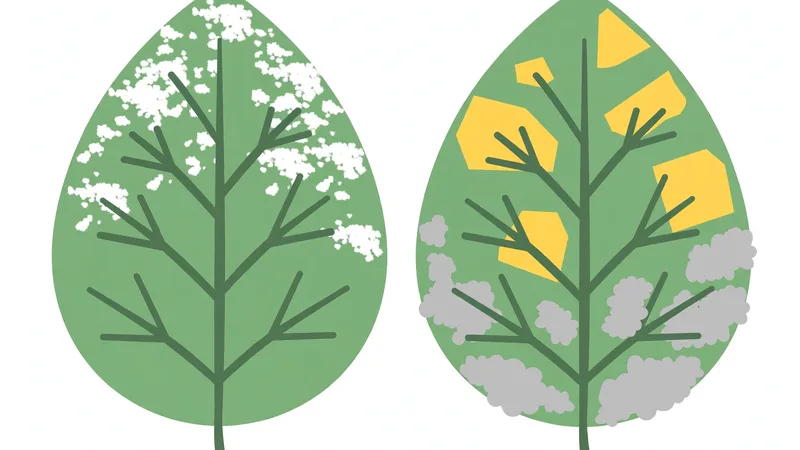
Powdery mildew and downy mildew are two different diseases that need different responses. Powdery mildew is a true fungus that grows as a white, powdery coating on the leaf surface — usually the upper surface first — and it does not need free water on the leaf to infect. Downy mildew is an oomycete, a water mould, that shows as yellow or pale patches on the upper leaf surface with grey to purple downy fuzz on the underside, and it needs leaf wetness or very high humidity. Flip the leaf: white powder on top means powdery mildew; yellow patches above with grey fuzz below means downy mildew. Spraying for one when you have the other wastes the spray, because the fungicide groups that control them are different.
Powdery mildew vs downy mildew: the one-minute distinction
Two different organisms with opposite water needs
Powdery mildews are true fungi — on cucurbits mainly Podosphaera xanthii and Erysiphe species, on grape Erysiphe necator. They are obligate parasites that live on the surface of the plant, and their spores germinate without free water; in fact, rain can wash spores off the leaf. They thrive in warm conditions with moderate humidity, which is why powdery mildew is common in dry summers when other leaf diseases are absent. Downy mildews are oomycetes — on cucurbits Pseudoperonospora cubensis, on grape Plasmopara viticola. They need liquid water or very high humidity for their spores to form and release swimming zoospores. Cornell's cucurbit downy mildew page states the contrast plainly: downy mildew makes a mosaic of chlorosis and dead tissue on the upper leaf, with grey spore growth underneath, while powdery mildew is a white powder covering the upper leaf surfaces — and often both diseases can be seen on the same crop at the same time. That last point matters: finding one does not rule out the other.
Powdery mildew in detail
Powdery mildew first appears as white, powdery spots that may form on both surfaces of leaves, on shoots and sometimes on flowers and fruit, according to UC IPM's Pest Notes on powdery mildew of vegetables. The spots gradually spread over a large area of leaves and stems. An exception noted by UC IPM affects artichoke, onion, pepper and tomato, where the disease produces yellow patches with little powdery growth — a useful warning not to rely on the powder alone on those crops. Infected leaves may gradually turn completely yellow, die and fall off, exposing fruit to sunburn. On cucurbits the first sign is often pale yellow spots on older leaves, which enlarge as white fluffy mycelium grows over the surface. On grape, the white to grey powder appears on young leaves first, the leaf often curls upward at the margins, and older colonies can show tiny black fruiting bodies. Because the fungus lives on the surface, it is visible early — but by the time the powder is obvious, infection began a week or more earlier, so scouting for the first small patches is what saves the crop.
Downy mildew in detail
Downy mildew on cucurbits begins as small, pale green to yellow angular spots between the veins on older leaves, as UC IPM's cucurbit identification guide describes. The spots are angular because the pathogen is confined by the leaf veins — a key field clue. The spots coalesce, the centres turn tan or brown and die, and the leaf eventually turns brown. On the underside, in humid or wet conditions, grey to purple-brown downy sporulation appears. On cucumber the angular pattern is usually sharp; Cornell notes that on squash and other cucurbits the lesions may be less sharply angular, so shape alone is not a reliable clue on every crop. On grape the classic sign is the yellow "oil spot" on the upper surface with white cottony sporulation underneath. Downy mildew is a disease of wet weather: it arrives with rain and heavy dew, spreads on wind-blown spores, and can defoliate a crop fast enough to cause sunscald and poor fruit quality. Cornell reports it arrives in New York each year between early July and late August, and its spread can be tracked through the cucurbit downy mildew forecasting system (ipmPIPE).
Side-by-side comparison
| Feature | Powdery mildew | Downy mildew |
|---|---|---|
| Organism | True fungus (e.g. Podosphaera xanthii, Erysiphe necator) | Oomycete (e.g. Pseudoperonospora cubensis, Plasmopara viticola) |
| Upper leaf | White to grey powdery coating | Yellow or pale angular patches, later brown dead centres |
| Underside | Powder sometimes visible | Grey to purple downy fuzz in humid conditions |
| Free water needed? | No — spores germinate without it | Yes — leaf wetness or very high humidity required |
| Weather it loves | Warm, moderate humidity, dry spells | Cool to warm, wet, rainy or dewy |
| Spot shape | Round powdery patches, spreading | Angular patches bounded by veins (often) |
| Speed | Builds over weeks | Can defoliate fast in wet weather |
| Fungicide groups | DMI (FRAC 3), SDHI (FRAC 7), QoI (FRAC 11), sulfur (M) | Oomycete groups: FRAC 4, 40, 49, P07 phosphonates |
The flip-the-leaf and hand-lens test
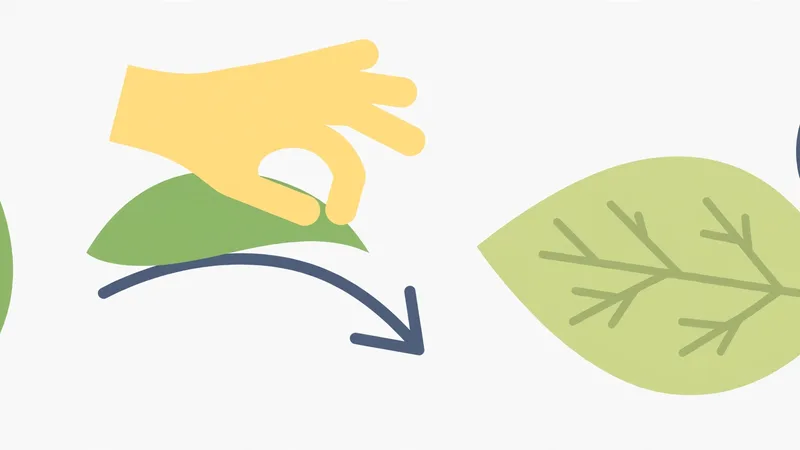
Do the test in the morning, when overnight humidity has encouraged sporulation. First look at the upper surface: a white powdery coating points to powdery mildew; yellow or pale patches point to downy mildew. Then flip the leaf. Grey, purple or dark fuzzy growth underneath a yellow patch is downy mildew. White powder underneath as well is still powdery mildew. A 10–20× hand lens strengthens the call: the cucurbit downy mildew identification guide notes that field workers can make a tentative diagnosis with a hand lens, but positive identification needs a compound microscope — so treat a field ID as a working diagnosis, not a laboratory result. Check several leaves on several plants, including older leaves where both diseases usually start. If the pattern is unclear after a careful inspection, contact your county extension office or a plant clinic rather than spraying for the wrong disease.
Management: the same habits, different chemistry
Cultural management overlaps for both diseases: space plants for airflow, avoid overcrowding, prune to open the canopy, water at the base in the morning so foliage dries, remove badly infected leaves into a bag, and grow resistant varieties where they exist. The chemistry diverges. Powdery mildew is controlled by fungicides active against true fungi — DMI, SDHI, QoI groups and multi-site materials such as sulfur — while downy mildew needs oomycete-active groups, and a DMI sprayed against downy mildew does nothing, just as a phosphonate sprayed against powdery mildew does nothing. Always check the current US label for the crop and your state before buying or applying anything, and rotate FRAC groups rather than repeating one mode of action; the FRAC guide in this series explains the rotation. Preventive timing matters more for downy mildew, because it moves fast in wet weather — once defoliation is advanced, no spray restores the lost leaves. For powdery mildew, early detection of the first small patches and protection of new growth is the winning approach.
What to do next
Walk the crop in the morning and flip five leaves. White powder on top means powdery mildew; yellow patches above with grey fuzz below means downy mildew. Photograph both surfaces, remove the worst leaves, open the canopy for airflow, and check the label for a product in the right FRAC group for your crop before you spray anything.
Check a mildewed leaf
Photograph the leaf top and underside and get a likely match — then compare it with the patterns in this guide.
Advisory note
This article is advisory guidance, not a definitive diagnosis. A photo-based check can narrow down the likely disease, but only laboratory confirmation or an extension officer's field visit gives a certain diagnosis. Never spray on the basis of a blog post alone — check the current product label and your local agriculture department advice first. No pesticide doses are given in this article.
By Ghulam Mustafa — Final-year BSc (Hons.) Agriculture student, specialising in Plant Pathology, The Islamia University of Bahawalpur (IUB), Pakistan. CGPA 3.98/4.00.
Frequently asked questions
How do I tell powdery mildew from downy mildew?
Look at both leaf surfaces. Powdery mildew is a white powdery coating, usually on the upper surface, and needs no free water. Downy mildew is yellow angular patches on the upper surface with grey to purple fuzz on the underside, and needs wet leaves.
Does powdery mildew need water to spread?
No. Unlike most leaf diseases, powdery mildew spores germinate without free water on the leaf, and rain can wash spores off. It spreads best in warm conditions with moderate humidity. Warm days, moderate humidity, spacing and airflow matter more than wet leaves, so improving air movement helps more than keeping foliage dry.
Can both mildews attack the same plant?
Yes. Cornell notes that powdery and downy mildew are often found on the same cucurbit crop at the same time. Finding one does not rule out the other, so check for both patterns. They are different organisms with different signs, so look for the white powder on top and the grey fuzz underneath before you decide.
Will the same fungicide control both mildews?
No. Powdery mildew (a true fungus) and downy mildew (an oomycete) respond to different fungicide groups. Using the wrong group wastes money and leaves the crop unprotected. Check the current label and rotate FRAC groups. The FRAC group on the label tells you which organism a product targets, so check the group rather than the brand name.
Can I confirm downy mildew in the field?
Tentatively, yes, with a hand lens — but positive identification needs a compound microscope. If the pattern is unclear, send a sample to your local extension clinic. A hand lens shows the grey-purple fuzz on the leaf underside, but spores seen under a microscope are the only sure confirmation.
Sources
- UC IPM — Cucurbits: Identify Pests and their Damage — consulted 2026-11-18
- UC IPM — Powdery Mildew on Vegetables (Pest Notes, UC ANR Publication 7406) — consulted 2026-11-18
- Cornell Vegetables — Downy Mildew (cucurbit downy mildew) — consulted 2026-11-18
- Cucurbit Downy Mildew ipmPIPE — Field Identification — consulted 2026-11-18
- Cornell Vegetables — General tips on identifying plant diseases — consulted 2026-11-18
Continue: Greenhouse disease prevention: sanitation, humidity and environmental management · How to diagnose plant diseases from leaf symptoms · Fungicide FRAC groups and resistance management