Guava fruit fly in Pakistan: identification and control
Published 2026-11-17

Guava fruit fly is the pest that ruins the summer guava crop in Pakistan: the female stings ripening fruit, lays her eggs inside, and the maggots eat the pulp from within until the fruit rots, drops and becomes unmarketable. The damage is worst in summer, the flies peak from April to June, and the control that works best is not a spray — it is bagging the fruit, trapping the males and cleaning up every fallen fruit.
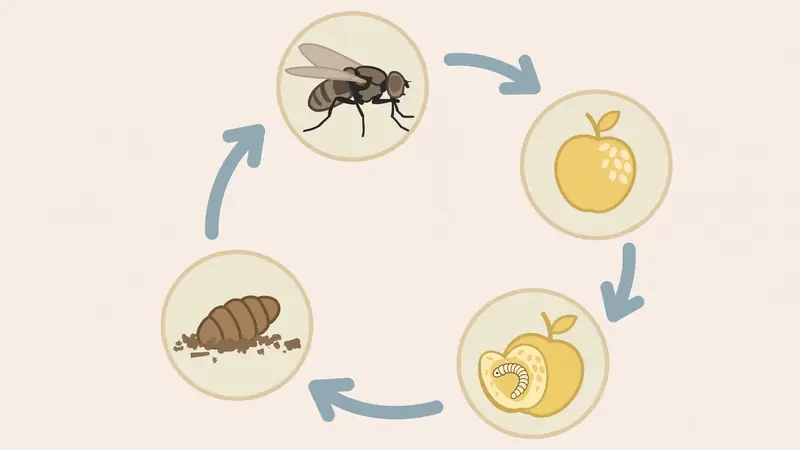

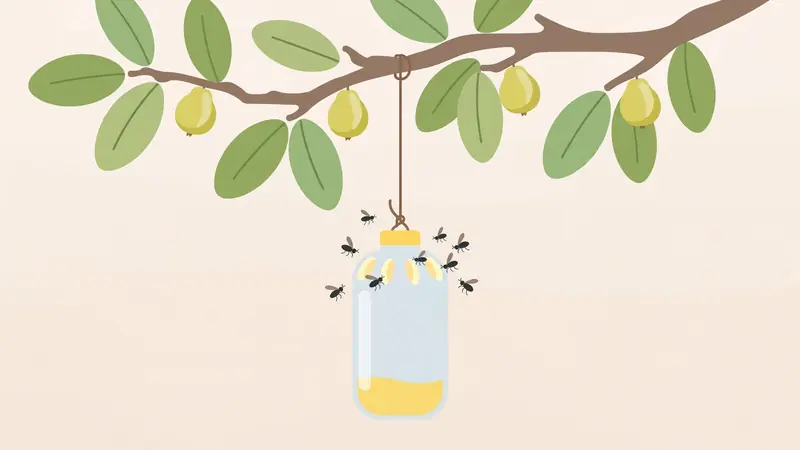
Which fruit flies attack guava in Pakistan?
Two fruit fly species do most of the damage to guava in Punjab: Bactrocera zonata, the peach fruit fly, and Bactrocera dorsalis, the oriental fruit fly. Both are tephritid flies whose females lay eggs in ripening or ripe fruit, and both are serious enough to act as a trade barrier for Pakistani fruit in foreign markets.
The flies also attack mango, melon, jujube and other fruit, so a guava orchard next to a mango orchard shares the same fly population. Guava is a preferred host, and in summer, when the fruit ripens fast in the heat, the damage is at its worst.
What does fruit fly damage look like?
Fruit fly damage starts with a tiny sting mark on the skin of a ripening fruit — a small puncture where the female laid her eggs. Inside, the eggs hatch into maggots that feed on the pulp, turning it soft, brown and rotten, and the fruit usually drops early. Cut open a fallen guava to find the maggots.
A fruit that looks fine on the outside can be ruined inside, which is why cutting open a few fruits every week is the only reliable check. In farm field assessments in Pakistan, unprotected guava orchards showed 44% fruit infestation by the end of the season — nearly half the crop.
When are fruit flies worst?
Fruit fly activity peaks from April to June in Punjab, which is exactly when the summer guava crop ripens. In trials across Faisalabad, Sargodha and Toba Tek Singh, those three months were the peak activity period in both years studied, and fly numbers rose with temperature.
The practical meaning is simple: traps and bagging must be in place before April, not after the damage appears. A grower who starts control in June is already a season late, because the flies that matter are the ones laying eggs in April and May.
How much damage do fruit flies cause?
In Pakistani farm field assessments, bait-sprayed guava orchards had 12% fruit infestation against 44% in unprotected orchards, and protected orchards held 20% more fruit on the trees — because fly attack makes fruit drop, infestation counts alone underestimate the loss. Across the fruit fly complex, losses of 20–90% have been reported in different areas of the country.
The national picture is large: extrapolating the field results across Pakistan, the assessments estimated a gross annual saving of about 4,915 million rupees from fruit fly control. For a single grower the arithmetic is simpler — nearly half the summer crop, or a tenth of it, depending on whether control was done.
How do I control guava fruit fly?
Control works best as a combination: keep the orchard clean, bag the fruit, trap the males, and use bait sprays — in that order of reliability for a small grower. No single method alone gives the result that the combination gives.
- Clean up every day. Collect and bury or destroy all fallen and infested fruit daily, so maggots never reach the soil to pupate and emerge as the next generation of flies.
- Bag the fruit. Cover young fruit with perforated polyethylene bags, which a Pakistani trial found reduced fruit fly damage more than newspaper or muslin cloth bags, with the best benefit-to-cost ratio. Bagging also protects the fruit from other pests and improves its quality.
- Trap the males. The male annihilation technique uses methyl eugenol lures to draw male flies into traps; simple pet-bottle traps caught the most flies in Punjab trials at the lowest cost, about 13.30 US dollars per hectare per year, with six traps per acre in the trials.
- Use bait sprays. Bait application technique — a protein bait mixed with insecticide, sprayed on part of the canopy — cut guava infestation from 44% to 12% in field assessments. It targets the flies that come to feed, not the whole orchard.
- Harvest on time. Pick fruit at the right maturity and do not leave ripe fruit hanging; overripe fruit is the most attractive to egg-laying females.
- Spray only as part of the combination. Cover sprays alone rarely control fruit fly well, because the maggots are protected inside the fruit. No doses are given here; check the current product label and local extension advice first.
What to do next
- Cut open five fallen guavas today and check for maggots — that is your infestation picture.
- Photograph a damaged fruit and check it on PhytoAssist.
- Put bottle traps up before April, bag the next fruit set, and collect fallen fruit every day.
Check a damaged guava
Cut open a fallen fruit and photograph what you find — then run the photo through PhytoAssist detection to compare the damage with fruit fly and other guava problems.
Advisory note
This article is advisory guidance, not a definitive diagnosis. A photo-based check can narrow down the likely disease, but only laboratory confirmation or an extension officer's field visit gives a certain diagnosis. Never spray on the basis of a blog post alone — check the current product label and your local agriculture department advice first. No pesticide doses are given in this article.
By Ghulam Mustafa — Final-year BSc (Hons.) Agriculture student, specialising in Plant Pathology, The Islamia University of Bahawalpur (IUB), Pakistan. CGPA 3.98/4.00.
Frequently asked questions
How do I know if my guavas have fruit fly?
Look for tiny sting marks on ripening fruit, fruit that softens and drops early, and maggots inside when you cut a fallen fruit open. A fruit that looks fine outside can be ruined inside, so cut open a few fruits every week during the season — that is the only reliable check.
Does fruit bagging really work?
Yes. A Pakistani trial on guava found bagged fruit had far less damage from fruit fly and other pests than unbagged fruit, and perforated polyethylene bags gave the best result with the best benefit-to-cost ratio. Newspaper and muslin cloth bags also helped. Bagging costs time, but it protects the fruit without any spray.
Will traps alone control fruit fly?
No. Male annihilation traps cut the male population and reduce mating, but they do not stop every female from laying eggs. Traps work when combined with orchard sanitation, bagging and bait sprays. A grower who only hangs traps and never cleans up fallen fruit will still lose a large share of the crop.
Is fruit fly damage worse in summer or winter?
Summer is far worse. The summer guava crop ripens in the heat when fly activity peaks from April to June, and infestation is severe. The winter crop suffers much less, which is one reason many growers value their winter guava more — the flies are simply less active in the cool season.
Sources
- Farm field assessments of fruit flies (Diptera: Tephritidae) in Pakistan: distribution, damage and control (ResearchGate) — consulted 2026-11-17
Curl returns 403 (bot protection); field results verified via search on 2026-11-17. - Monitoring and management of fruit fly population using the male annihilation technique with cost-effective traps in guava orchards of Punjab, Pakistan (International Journal of Pest Management, 2022) — consulted 2026-11-17
Curl returns 403 (bot protection); trial findings verified via search on 2026-11-17. - On tree fruit bagging influences quality of guava harvested at different maturity stages during summer (International Journal of Agriculture & Biology, 2014) — consulted 2026-11-17
Continue: Analyse a photo of the damage · Mango malformation in Pakistan · Citrus canker in Pakistan · SabziPlan — seasonal crop planner