Wheat rust in Pakistan: yellow, brown and black rust — symptoms and control
Published 2026-11-17
Wheat rust is not one disease but three — yellow (stripe) rust, brown (leaf) rust and black (stem) rust — each caused by a different Puccinia fungus, each with its own colour, pattern and favourite weather. In Pakistan, an early stripe rust attack can cost 20–50% of yield, and leaf rust typically takes 20–30%, according to the Wheat Research Institute booklet as summarised by FasalBachao. The first skill is telling them apart, because the control decision follows the identification.
What is wheat rust?
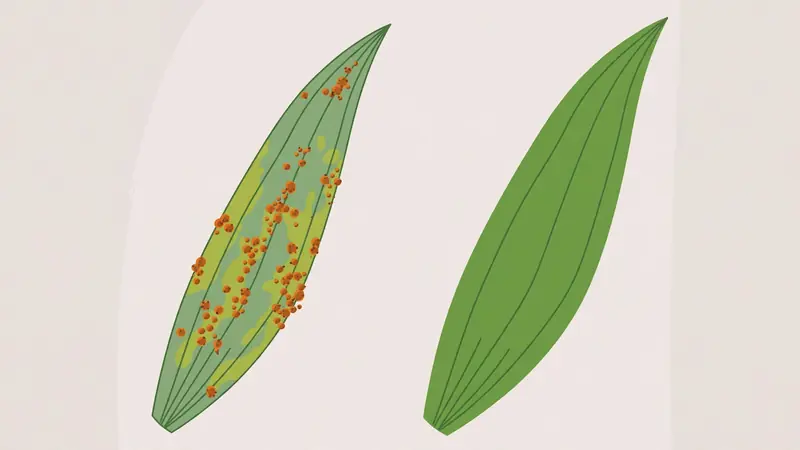
Wheat rust is a group of three fungal diseases of wheat caused by Puccinia fungi, recognised by powdery, rust-coloured pustules on leaves and stems. The fungi are obligate parasites — they can only grow on living plant tissue — and they spread by wind-blown spores.
Under the right weather, those spores can turn a few pustules into a field-wide epidemic within weeks. The Wheat Research Institute (WRI) of the Ayub Agricultural Research Institute, Faisalabad, calls rust a threat to food security, because wheat meets more than 75% of Pakistan's food requirement.
How do I tell yellow, brown and black rust apart?
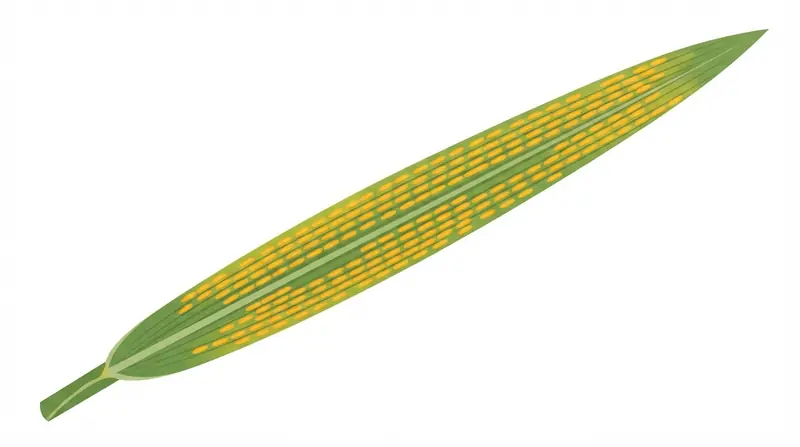
Look at the colour and the arrangement of the pustules, not just the colour of the leaf. Yellow rust makes orange-yellow pustules in clear stripes along the leaf veins; brown rust makes scattered orange-brown pustules at random on the upper leaf surface; black rust makes larger dark-red pustules that tear open the stem surface.
The pustules turn black late in the season. Stripe pattern is the giveaway — only yellow rust lines its pustules up in rows.
| Feature | Yellow rust (stripe rust) | Brown rust (leaf rust) | Black rust (stem rust) |
|---|---|---|---|
| Fungus | Puccinia striiformis f. sp. tritici | Puccinia triticina | Puccinia graminis f. sp. tritici |
| Pustule colour and pattern | Orange-yellow pustules in clear stripes along veins | Orange-brown pustules, scattered singly at random | Orange-red to dark-red oval pustules, tearing the stem surface |
| Where it appears | Leaves, sometimes the head | Leaves, mainly upper surface | Stems and leaves, sometimes head and grain |
| Temperature for spread (WRI booklet) | 12–20 °C | 15–22 °C | 20–30 °C |
| Yield damage (WRI booklet) | Early attack can cost 20–50% | Yield falls 20–30% | Can destroy entire fields; up to 100% in severe cases |
| Where in Punjab | Mostly northern Punjab and some central districts, now spreading wider | Almost all districts, most widespread | Long minor in Punjab; found in parts of Sindh (Hyderabad, Badin) in 2006–07 |
What does yellow rust look like in the field?
Yellow rust first shows as small yellowish patches on the leaf, followed by bright yellow-orange pustules lined up in conspicuous stripes along the veins. The stripes are the diagnostic feature: no other wheat disease arranges its pustules in rows. It is the cool-weather rust — it infects at just 7–12 °C and develops fastest at 10–15 °C.
It explodes in cool, wet late-winter weather and fades as temperatures climb. The WRI booklet reports it attacks mostly northern Punjab and some central districts, from Rawalpindi to Faisalabad, but notes it is now seen across the whole province as the climate changes, and warns it damages the crop more than brown rust.
What does brown rust look like in the field?
Brown rust shows as small orange-brown powdery pustules scattered singly and at random on the upper surface of the leaves — no stripes, no rows. It is the most widespread of the three rusts in Punjab, attacking almost uniformly in nearly all districts.
The WRI booklet records that it can take epidemic form. It infects best at 15–20 °C with at least six hours of moisture on the leaf, so dewy, mild spells during tillering and stem elongation are its favourite window. Its worst damage happens when the upper leaves are heavily rusted before flowering, because dead upper leaves shorten grain filling and leave smaller, lighter kernels.
What does black rust look like, and should I worry about Ug99?
Black rust makes larger, oval, orange-red to dark-red pustules that burst through the surface of stems and leaves so the tissue looks torn; severely infected stems weaken, lodge, and produce shrivelled, prematurely ripened grain. Late in the season the pustules turn black — hence ‘black rust’.
It is the warmth-loving rust, developing fastest at 26–30 °C, so a hot, humid spell late in the season is its moment. The WRI booklet notes stem rust has long been unimportant in Punjab, but warns specifically about the race called Ug99 (TTKSK), detected in Uganda in 1998, which defeats many of the resistance genes in widely grown wheat varieties; CIMMYT reports Ug99-lineage variants have since spread through eastern and southern Africa to Yemen, Iran and Egypt. For a Punjab grower, black rust is a watch-list disease, not the everyday threat — but that is exactly why resistant varieties matter even in years when it does not appear.
Can yellow leaves alone prove my wheat has rust?
No — yellow leaves alone do not prove stripe rust, and this is the most common misdiagnosis in wheat fields. A crop can yellow for other reasons, such as nutrient deficiency, waterlogging or cold damage, so confirm the striped pustules before you decide to spray.
Look for the actual pustules: small yellow-orange blisters in lines along the veins, which rub off as powdery dust on your fingers. If there are no pustules, the yellowing is something else, and spraying a rust fungicide will waste money and chemistry. When in doubt, photograph the leaf and check it on RustWatchPK or PhytoAssist, or take a sample to your local agriculture office for confirmation.
When should I scout for wheat rust?
Rust control is mostly a calendar discipline: the growers who lose least are the ones who look at the right time. The WRI booklet's dates, adapted into a Punjab surveillance calendar below, give the two dates that matter most — sow by 20 November, and start scouting after 20 January.
For a ready-made version of this calendar with the three rusts and their look-alikes, see RustWatchPK's surveillance calendar.
| Month | What to do |
|---|---|
| November | Finish sowing by 20 November. Use clean, healthy, treated seed. Do not sow a single old or banned variety across the whole farm. |
| December | Crop establishes. Check emergence and variety mix — several varieties with different resistance backgrounds mean one rust race cannot take the whole farm. |
| January | From 20 January, start regular field inspection. Watch the weather: cool, wet spells are stripe rust weather. |
| February | Peak stripe rust window. Scout weekly, lower leaves first, then the flag leaf. A patch of rust is where an epidemic starts — do not ignore a small patch. |
| March | Flag leaf emergence to heading is the most valuable protection window. Leaf rust pressure rises as temperatures reach 15–22 °C. Protect the flag leaf — it feeds the grain. |
| April | Hot spells bring stem rust risk. Stop all pesticide sprays 40 days before harvest — residues in grain are a health hazard, and the WRI booklet states this as a red-letter rule. |
Which wheat varieties resist rust in Pakistan?
Resistant varieties are the cheapest and strongest rust control there is: the Wheat Research Institute booklet calls genetic resistance the best method of all, because it adds no extra cost and is completely environment-friendly. Stop growing old, banned or unapproved varieties that have become susceptible, and grow the newly approved rust-resistant varieties recommended by the Agriculture Department.
Varieties named as resistant in the WRI booklet's time include Faisalabad-2008, Aas-2011, NARC-2011, Pakistan-2013, Ujala-2016, Bhakkar Star, Johar-16, Anaj-17, Markaz-19, Akbar-19 and Ghazi-19; varieties it warns have lost their resistance include Inqlab-91, Bhakkar-2002, Shafaq-2006, Seher-2006 and Galaxy-2013. Recent UAF trial work used Anaj-2017 and Dilkash-2020 as rust-resistant varieties. Both lists date fast — rust fungi constantly form new races that overcome a variety's resistance, so a variety that was safe five years ago may not be safe now. Rule: check the current season's approved variety list from the Agriculture Department before sowing, and never rely on one variety across your whole farm.
What should I do first when I find rust?
Confirm the rust, judge the crop stage, and act at the first confirmed appearance — late spraying is expensive and ineffective, according to the WRI booklet. The most valuable spray window runs from flag-leaf emergence to full heading, with full boot the ideal moment for a single spray.
- Confirm it. Check for pustules in the pattern above — stripes for yellow rust, scattered pustules for brown rust, torn stems for black rust. Yellow leaves without pustules are not a diagnosis.
- Judge the stage. If rust is on the flag leaf or spreading fast, the window to act is now. If it is a small patch on lower leaves in January, mark the spot and re-check in three days — a patch is where an epidemic starts.
- Spray at the right moment, not the latest moment — except stripe rust, which cannot wait for a growth stage and should be sprayed as soon as active hot spots are found.
- Use one active ingredient, then rotate. The fungicide active ingredients named in Pakistani guidance include propiconazole, tebuconazole, difenoconazole, triadimefon, azoxystrobin and trifloxystrobin combinations. Rotating between FRAC mode-of-action groups (for example, a Group 3 triazole followed, if a second spray is truly needed, by a Group 11 + 3 mixture) slows resistance. No doses are given here — verify the dose, crop registration and pre-harvest interval against the current product label before use.
- Fix the conditions. Avoid over-dense sowing and heavy irrigation, avoid heavy nitrogen doses, keep weeds down, and control volunteer wheat plants that carry rust between seasons.
Is there any biological control for wheat rust?
Yes — as research, not yet as a field prescription. A 2026 study from the Department of Plant Pathology, University of Agriculture, Faisalabad, tested seed-primed biocontrol agents (Trichoderma sp. and Bacillus sp.), with and without biochar, against wheat leaf rust (Puccinia triticina) under field conditions.
Trichoderma seed priming significantly improved growth and yield traits — up to about 79% higher yield per plant and 56% higher grain weight per spike — while reducing brown rust severity by about 60% compared with the control. The same paper notes leaf rust causes 25–50% yield losses depending on conditions. The authors also note the biocontrol-plus-biochar combinations were not consistently superior, so the response is context-dependent.
That single trial is genuinely interesting — it connects directly to the author's own work with Bacillus and Trichoderma isolates — but one trial is not a recommendation. No biocontrol product is presented here as a proven rust treatment for Pakistani wheat fields, and any seller claiming otherwise should be asked for trial data.
How does rust spread so fast?
Rust spreads by wind-blown spores, and under the right weather it multiplies fast enough to turn a few pustules into an epidemic within weeks. A spore that lands on a wet leaf can infect within hours of moisture — roughly six hours of leaf wetness for leaf rust.
Six to eight hours of wetness suits stem rust, and about eight hours suits stripe rust. A new generation of pustules appears just 7 to 10 days after infection. The epidemic recipe is three ingredients together: susceptible varieties over wide areas, timely rain, and humidity above 70%.
What to do next
- If your wheat is in the ground now, check the calendar above and scout this week — after 20 January, weekly.
- Photograph any striped or pustuled leaf and identify it on RustWatchPK or PhytoAssist.
- Before next sowing, get the current approved variety list and plan the rotation with SabziPlan — and note which variety rusted this year, so it does not get sown again.
Identify the rust on your wheat
Answer the pattern questions — stripes, scattered pustules or torn stems — and get a likely rust type with the surveillance calendar for your crop.
Advisory note
This article is advisory guidance, not a definitive diagnosis. A photo-based check can narrow down the likely disease, but only laboratory confirmation or an extension officer's field visit gives a certain diagnosis. Never spray on the basis of a blog post alone — check the current product label and your local agriculture department advice first. No pesticide doses are given in this article.
By Ghulam Mustafa — Final-year BSc (Hons.) Agriculture student, specialising in Plant Pathology, The Islamia University of Bahawalpur (IUB), Pakistan. CGPA 3.98/4.00.
Frequently asked questions
What is the difference between yellow rust and brown rust?
Yellow (stripe) rust makes orange-yellow pustules arranged in clear stripes along the leaf veins and prefers cool weather (12–20 °C). Brown (leaf) rust makes scattered orange-brown pustules at random on the upper leaf surface and prefers mild weather (15–22 °C). Yellow rust damages the crop more than brown rust when it attacks early.
How much yield can wheat rust take?
According to the Wheat Research Institute booklet, leaf rust takes 20–30% of yield and an early stripe rust attack 20–50%; stem rust can destroy entire fields in severe cases. Actual loss depends on variety, timing and weather — an early attack on a susceptible variety is always the expensive one.
When should wheat rust be sprayed?
At the first confirmed appearance, protecting the flag leaf — the most valuable window is flag-leaf emergence to full heading, with full boot the ideal moment for a single spray. Stripe rust hot spots should be sprayed as soon as they are found, without waiting for a growth stage. Stop all sprays 40 days before harvest.
Which wheat variety is resistant to rust in Pakistan?
Check the current season's approved list from the Agriculture Department — the list changes as rust races evolve. The WRI booklet's older list is dated, and a variety that was safe five years ago may not be safe now. Recent UAF trial work used Anaj-2017 and Dilkash-2020 as rust-resistant varieties. Never plant one variety across the whole farm.
Can rust spread from wheat to other crops?
Wheat rusts are specific to wheat and closely related cereals; they do not attack unrelated crops such as cotton, maize or vegetables. Volunteer wheat plants and nearby wheat fields are the real source of spread, so controlling volunteers and checking neighbouring fields matters more than worrying about other crops.
Sources
- FasalBachao — “Wheat Rust Control: Leaf, Stripe & Stem Rust Guide” (summary of the WRI/AARI booklet) — consulted 2026-11-17
WRI booklet figures are quoted as summarised here; the original WRI booklet was not consulted directly. - Synergetic Effect of Seed-Primed Biocontrol Agents and Biochar Soil Amendment on Wheat Productivity and Leaf Rust Suppression (University of Agriculture, Faisalabad; Integrative Plant Biotechnology 04(1) 2026, 73–83) — consulted 2026-11-17
- Times Agriculture — “Rust causes yellowishness in wheat. Checking Methods and management strategies” (updated 25 Jun 2026) — consulted 2026-11-17
- Medium / Naya Savera — “How to Protect Your Wheat Crop from Fungal Diseases in 2026” (8 Apr 2026) — consulted 2026-11-17
Continue: Analyse a photo of the symptom · Wheat leaf rust in the encyclopedia · RustWatchPK — wheat rust identifier and surveillance calendar · SabziPlan — seasonal crop planner