Tomato early blight in Pakistan: symptoms, identification and control
Published 2026-11-17
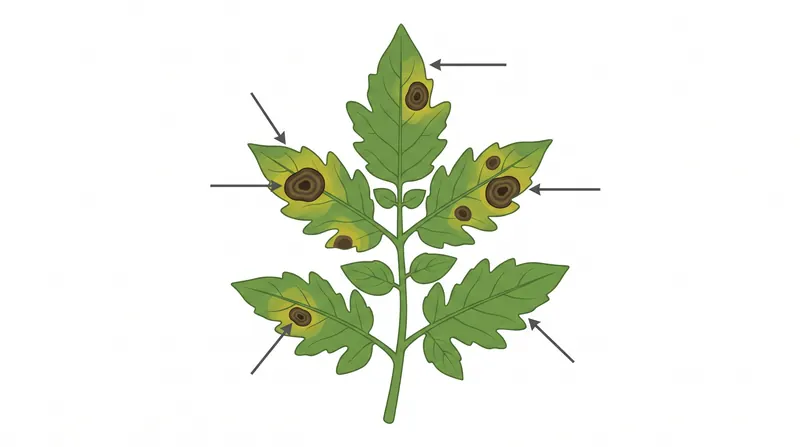
Tomato early blight is a fungal disease caused by Alternaria solani that starts as small brown spots with concentric rings on the oldest, lowest leaves, then spreads upward, yellowing and defoliating the plant. In Punjab, it causes 30–60% yield loss during humid monsoons, so recognising the ring pattern early is the single most valuable skill a tomato grower can learn.
What is tomato early blight?
Tomato early blight is a fungal disease of tomato caused by Alternaria solani, and it attacks leaves, stems and fruit at any stage of growth. The name ‘early’ distinguishes it from late blight (Phytophthora infestans), not because it only appears early in the season — it can strike from seedling to harvest.
According to the National Institute for Food and Agriculture (NIFA), Tarnab, Peshawar, the disease occurs in both summer and winter tomato crops in Khyber Pakhtunkhwa, with high levels in the winter crop.
How do I know if my tomato plant has early blight?
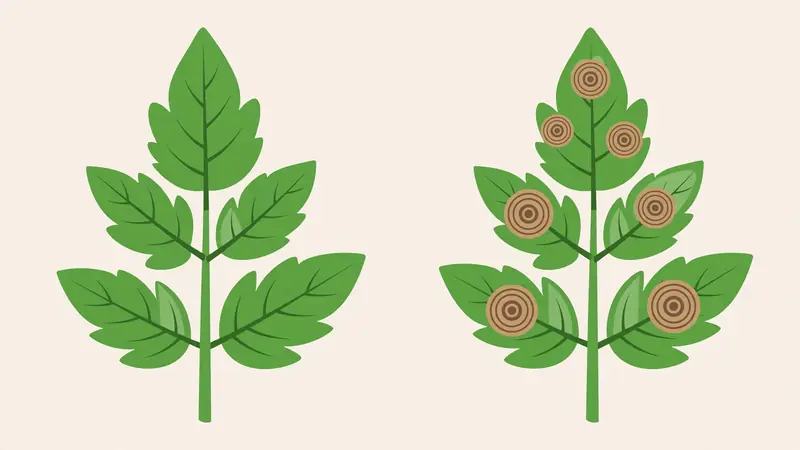
Check the lowest, oldest leaves first. Early blight begins there as small brown spots that enlarge to roughly 6–12 mm across and develop dark concentric rings — a ‘target-board’ or bull’s-eye pattern — with yellow areas around each lesion. Affected leaves turn yellow, wither and drop off.
The disease climbs the plant leaf by leaf. Fruit lesions appear near the stem end as dark, leathery, sunken spots with the same rings.
If you want a second opinion on a photo of the leaf, upload it to PhytoAssist’s photo-based disease detection or the TomatoTriage tomato health advisor — but treat any photo result as a likely match, not a laboratory diagnosis.
- Start at the bottom. Early blight almost always starts on the oldest leaves nearest the soil; a disease that starts on young top growth is probably something else.
- Look for rings. Hold the leaf up to the light. Concentric dark rings inside a brown spot are the signature of Alternaria solani. No rings means keep looking — Septoria and bacterial spot do not make them.
- Check the yellow halo. Yellow tissue around the spot, spreading as the spot grows, is typical of early blight.
- Check stems and fruit. Dark, target-like cankers on stems and leathery dark lesions at the stem end of fruit confirm the pattern. A large, girdling, dark-brown sunken lesion at the stem base is collar rot — the same fungus on a young plant.
- Note the weather. Warm, humid conditions with wet leaves favour early blight. If the last week was cool and rainy, consider late blight instead (see the comparison table below).
What does early blight look like on tomato leaves?
Early blight on tomato leaves looks like brown, circular spots with dark concentric rings like a target, surrounded by yellowing tissue, beginning on the lower leaves. The spots enlarge until they are about 6–12 mm across, and heavily spotted leaves wither and fall.
In severe cases the plant defoliates from the bottom up, exposing fruit to sunscald.
The NIFA description is the clearest field reference for Pakistan: “small, brown spots on the lower or older leaves… soon develop dark, concentric rings or ridges, producing a ‘target-board’ effect. Affected leaves develop yellow areas around the lesions. Spotted leaves soon turn yellow, wither, and drop off.” On fruit, the lesion is “dark brown to black, up to an inch in diameter, leathery, depressed, and with distinct concentric rings,” often covered with a dark-brown velvety layer of spores.
How bad is early blight in Pakistan?
Early blight is one of the most damaging tomato diseases in Pakistan. A PMAS-Arid Agriculture University study reports yield loss of 30–60% in Punjab tomatoes during humid monsoons, and early blight incidence of 75–92% in Sargodha, Rawalpindi and Faisalabad districts during the monsoon season.
The study was presented at the 9th International Conference on Horticulture and Expo 2025 (Rawalpindi, April 2025; published 24 April 2026). The researchers isolated A. solani from the Nagina cultivar at the university research farms in Rawalpindi in August 2025, at peak disease pressure.
Early blight vs late blight vs Septoria: how to tell them apart
Most misdiagnosis happens because three leaf-spot diseases look similar at a glance. The table below separates them in the field.
The single most useful rule: rings mean early blight; water-soaked speed means late blight; tiny grey-centred spots mean Septoria. If you see white fuzzy growth on the underside of leaves on a cool wet morning, treat it as late blight until proven otherwise and act the same day — late blight does not wait.
| Feature | Early blight (Alternaria solani) | Late blight (Phytophthora infestans) | Septoria leaf spot (Septoria lycopersici) |
|---|---|---|---|
| Spot pattern | Large brown spots with concentric rings (target) | Large water-soaked, greasy lesions, no rings | Many tiny spots, grey centres, dark borders, no rings |
| Spot size | 6–12 mm, enlarging | Expands fast, several cm in days | 1.5–3 mm, stays small |
| Where it starts | Oldest lower leaves | Any leaves, often after rain; whole plant fast | Lower leaves, moves up |
| Yellow halo | Yes, around lesions | Pale green/yellow margin on water-soaked tissue | Sometimes, slight |
| Fruit symptoms | Dark leathery sunken lesion at stem end | Firm brown rot, often whole fruit | Rare on fruit |
| Weather it loves | Warm and humid | Cool and wet | Cool, prolonged leaf wetness |
| Speed | Days to weeks, climbing upward | Days — can destroy a plant in a week | Weeks, slower |
| White mould underneath | No | Yes, on leaf underside in humid mornings | No — tiny black dots inside spots instead |
Can tomato plants recover from early blight?
Tomato plants can recover from early blight if it is caught early, infected leaves are removed, and healthy foliage is protected — but the disease cannot be cured out of already-spotted leaves. Spotted leaves will not heal; the goal is to slow the climb up the plant.
The upper leaves must stay healthy long enough to fill the fruit. Once defoliation is severe and fruit is exposed to sunscald, recovery is unlikely and the crop is best managed for whatever fruit can still be saved.
What should I do first when I see early blight?
Act the same day you confirm the ring pattern. Early blight spreads upward leaf by leaf, so a week of delay can cost the lower third of the canopy — and every spotted leaf left on the plant is shedding spores onto the healthy leaves above it.
- Remove infected leaves. Pick off spotted lower leaves, put them in a bag, and destroy them away from the crop — do not compost them and do not leave them on the soil, where spores survive. Wash your hands and tools afterwards.
- Improve air flow. Space plants so leaves dry quickly, stake or tie plants up off the soil, and prune the lowest leaves that touch the ground.
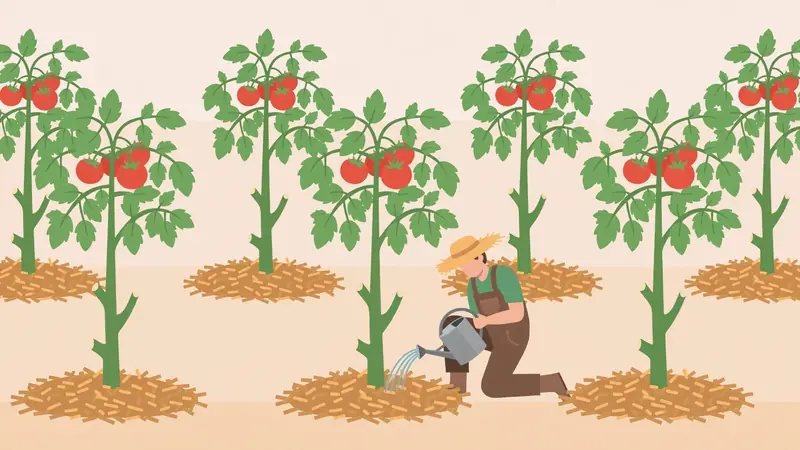
- Stop wetting the leaves. Water at the base, in the morning, so foliage dries during the day. Overhead watering and evening watering both keep leaves wet overnight, which is what the fungus needs.
- Mulch the soil. A mulch layer stops soil — and the spores in it — splashing onto lower leaves in rain or irrigation.
- Check the whole plot. Early blight rarely hits one plant. Inspect neighbours, and remove badly infected plants entirely if they are shedding spores onto healthy ones.
- Get a second opinion. Photograph the leaf (top and underside, with a coin for scale) and run it through PhytoAssist or TomatoTriage. If the pattern does not match early blight, do not spray for it.
Which tomato varieties resist early blight in Pakistan?
Variety choice is the cheapest control available, and Pakistani research has tested the varieties growers actually buy. A University of Agriculture, Faisalabad study screened six commercial tomato varieties against Alternaria solani: only Johir showed a resistant response; Nadir F1 and Gohar were moderately susceptible; Walter Giant FM9 was susceptible; and Naqeeb F1 and Money Maker were highly susceptible.
The same study tested micronutrient sprays and found they reduced disease severity compared with the untreated control, with results varying by variety — but that was one field trial, not a recommendation to mix and spray fertiliser salts yourself. The paper's abstract and its results table report different severity baselines, so no single percentage from that trial is quoted here.
Practical rule: ask your seed supplier which of their current varieties carries early blight tolerance, and treat any variety claim as a starting point, not a guarantee — resistance varies with the local Alternaria population and the season.
What about fungicides and biological control?
Fungicides are named here only as active ingredients reported in the sources — no doses are given in this article, and no dose copied from a blog should ever be used. Always check the current product label and your provincial agriculture department's advice, and use only products registered for tomato in Pakistan.
The 2026 PMAS-AAU laboratory study screened five fungicides against Alternaria solani and found difenoconazole gave the strongest inhibition in the laboratory test; the authors suggest alternating difenoconazole and propineb-based products to reduce resistance selection pressure. NIFA's older guidance also lists captan and mancozeb-based protectants — but a laboratory ranking is not a field prescription, and products and registrations change.
On biological control: Bacillus and Trichoderma species are the subject of active Pakistani research — the author's own work involves around 15 Bacillus isolates and 3 Trichoderma isolates in antagonism assays — and a 2026 University of Agriculture, Faisalabad study on wheat leaf rust found Trichoderma seed priming reduced rust severity by about 60% in that trial. Those are promising research directions, not field-ready tomato recommendations: no Bacillus or Trichoderma product is presented here as a proven early blight treatment for tomato in Pakistan.
The honest hierarchy for early blight control is: resistant variety first, clean seed and transplants second, spacing and dry foliage third, removal of infected leaves fourth — and fungicide as a protectant for healthy foliage, not a cure for spotted leaves.
How to prevent early blight next season
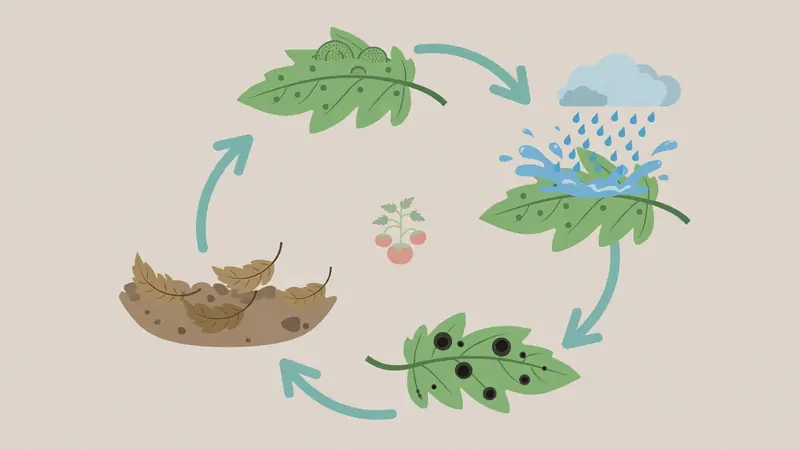
Prevention is mostly about breaking the fungus's year-to-year cycle. Alternaria solani survives in infected plant debris and soil, and on seed.
- Rotate crops. Do not plant tomato (or potato, brinjal or chilli) in the same plot season after season. PhytoAssist's crop-rotation planning tool can map a rotation that keeps solanaceous crops apart.
- Start clean. Buy disease-free certified seed and transplants. Discard any seedling with stem cankers or leaf lesions at transplanting — one infected transplant can seed a whole plot.
- Clear debris. Remove and destroy all tomato debris at the end of the season; the fungus overwinters in it.
- Plan the kitchen garden too. Home growers can use SabziPlan to schedule sowing and rotation so tomatoes do not follow tomatoes.
- Scout weekly in the monsoon. From first flowering onward, check the lowest leaves every week — the 75–92% monsoon incidence figures from Punjab show what happens when scouting stops during the rains.
What to do next
- Walk your tomato plot today and check the lowest leaves for the ring pattern.
- Photograph anything suspicious (top and underside, with a coin for scale) and check it on PhytoAssist or TomatoTriage.
- Remove infected leaves, water at the base, and plan next season's rotation — and note the variety name that got hit hardest, so you can choose differently next time.
Check a spotted tomato leaf
Answer six quick questions about the spots and get a likely match with next steps — then compare the result with the ring pattern in this article.
Advisory note
This article is advisory guidance, not a definitive diagnosis. A photo-based check can narrow down the likely disease, but only laboratory confirmation or an extension officer's field visit gives a certain diagnosis. Never spray on the basis of a blog post alone — check the current product label and your local agriculture department advice first. No pesticide doses are given in this article.
By Ghulam Mustafa — Final-year BSc (Hons.) Agriculture student, specialising in Plant Pathology, The Islamia University of Bahawalpur (IUB), Pakistan. CGPA 3.98/4.00.
Frequently asked questions
Is early blight the same as late blight?
No. Early blight is caused by Alternaria solani and shows concentric-ring spots starting on lower leaves in warm, humid weather. Late blight is caused by Phytophthora infestans, shows fast-spreading water-soaked lesions in cool, wet weather, and can destroy a plant within days.
Can I eat tomatoes from a plant with early blight?
Fruit without lesions is generally fine to eat after washing, since early blight does not make the fruit itself unsafe. Fruit with dark, leathery, sunken lesions should be discarded, not eaten or cooked. When in doubt about a tomato, throw it out — one fruit is not worth the risk.
Does early blight spread to other vegetables?
Alternaria solani mainly attacks tomato and potato, and can affect brinjal. It does not attack unrelated vegetables such as okra or cucurbits, so a tomato infection does not threaten those crops. Rotate away from all solanaceous crops — tomato, potato, brinjal and chilli — to break the cycle.
Should I spray the whole plant or just the sick leaves?
Remove sick leaves first, then protect the healthy foliage that remains. Spraying spotted leaves will not heal them, so there is no point treating leaves that are already damaged. Any spray decision needs the current product label and local extension advice before you buy or apply anything.
Sources
- NIFA, Plant Protection Division, Tarnab, Peshawar — “Early Blight of Tomato” — consulted 2026-11-17
- Screening of Fungicides for the Management of Early Blight of Tomato Caused by Alternaria solani (PMAS-Arid Agriculture University, Rawalpindi; published 24 Apr 2026) — consulted 2026-11-17
- Morphological Assessment of Resistance Potential in Tomato Against Early Blight Disease and Its Management (University of Agriculture, Faisalabad) — consulted 2026-11-17
- Agriculture dept urges tomato farmers to take preventive against early blight threat, Balochistan Times, 15 Apr 2025 — consulted 2026-11-17
- Almanac — Tomato Leaf Problems: How to Identify, Prevent, and Treat Common Diseases — consulted 2026-11-17
- Gardenia — Tomato Diseases: Identification, Treatment & Prevention — consulted 2026-11-17
Continue: Analyse a photo of the symptom · Browse tomato diseases in the encyclopedia · TomatoTriage — tomato plant health advisor · SabziPlan — kitchen-garden planner